
The National Training and Development Curriculum (NTDC): Curriculum Components, Resources, and New Enhancements
Adoption Advocate No. 188 - The National Training and Development Curriculum (NTDC) is a comprehensive program that helps to prepare prospective adoptive parents to be successful parents.
Quick Look: What’s New in NTDC?
You Asked, We Listened!
- Training materials are now available with Spanish translation!
- New and expanded content, including:
- Prenatal drug exposure
- Medical special needs
- Cultural curiosity and belonging
- Birth parent experiences and birth family contact
- E-learning adoption-specific versions of classroom-based trainings
- New resources for creatively integrating NTDC!
- How to integrate the Self-Assessment into the home study process
- How to use Right Time Trainings in support groups
- NTDC successes:
- Widespread Implementation: 44 states and counting!
- Newly rated as having promising research evidence by the CA Evidence-Based Clearinghouse
An Overview: What is NTDC?
The National Training and Development Curriculum (NTDC) is a free, comprehensive training curriculum designed to prepare and equip foster, kinship, and adoptive families for their parenting journey with a child who has experienced trauma, separation, and loss.[1] It is a state-of-the-art classroom and online program that helps to prepare prospective adoptive parents to be successful parents. In addition, the NTDC gives adoptive parents access to information and resources needed to continue building skills once they have a child in their home.
NTDC is designed for three target populations:
- Families who foster, provide kinship care, and/or adopt children from the child welfare system,
- Families who adopt via the intercountry or private domestic process, and
- American Indian Alaska Native families who foster, provide kinship care, and/or adopt children from the tribal child welfare system.
NTDC goes deeper than many traditional training programs, infusing adult learning theory, self-directed learning, transformative learning, and a layered curriculum approach into every aspect of the program. This curriculum and the accompanying resources are free for all public and private child welfare agencies.
Background: The Need for & Development of NTDC
Child welfare systems across the country have struggled to recruit and retain quality foster parents to care for the nearly 400,000 youth in care nationwide.
The National Training and Development Curriculum for Foster and Adoptive Parents was developed to fill in this gap in training. NTDC is a collaborative research-based curriculum that brings together input from families who have experience with fostering or adopting children; and former foster and adoptive youth, including adult adoptees. The project has been adopted by 35 states and 7 tribal child welfare systems.
Funded through a five-year cooperative agreement with the Children’s Bureau, NTDC was developed and is being led by Spaulding for Children in partnership with National Council For Adoption (NCFA), Center for Adoption Support and Education (C.A.S.E), ChildTrauma Academy, Families Rising, and the University of Washington School of Social Work.
Developed With Your Agency in Mind
After reviewing academic scholarship and existing curricula, interviewing parents and young adults, and working with content specialists, NTDC was developed. This curriculum was piloted in seven states, one tribe, and a few private adoption agencies.
From the beginning, NTDC materials were designed to be relevant for private domestic and intercountry adoption and can even be used to meet many of the federal requirements for Hague-compliant adoptions. Learn more about NTDC’s focus on private adoption here.
The National Training and Development Curriculum was created utilizing robust social science application in partnership with the nation’s leading content experts. The curriculum was informed by a variety of methods, including:
- A comprehensive systematic literature review to determine factors that promote successful foster and adoptive parenting.
- A review of existing training materials for prospective foster or adoptive parents, and analysis of best practices used in implementing these trainings.
- A survey of state child welfare officials to determine essential training topics for parents interested in fostering or adopting; identify topics currently included in trainings; identify parent training topics required by policy or law; and gather feedback on how to improve training for parents interested in fostering or adopting.
- Individual interviews with stakeholders, including seasoned foster and adoptive parents, young adults with lived experience in the foster care system, and adult adoptees. These interviews helped identify what foster and adoptive parents wish they had known when they were preparing for their parenting role, and what young adults wish their foster or adoptive parents had known.
- A review of expert opinions of more than 200 professionals and parents nationwide, regarding topics that should be included in a curriculum for parents interested in fostering or adopting.
-
The National Training and Development Curriculum was created utilizing robust social science application in partnership with the nation’s leading content experts.
-
Data gathered through these various sources were compiled into a list of topic areas and themes. That list was then provided to a panel of national experts who rated the listed items in terms of priority for inclusion in a curriculum that could be delivered in approximately 27 hours of training. This rating process (also known as the Delphi process) was used to reach consensus around the final topics selected for inclusion in NTDC.
An Evidence-Based Curriculum: Evaluations of NTDC
NTDC is the most extensively studied curriculum that trains foster and adoptive parents in the nation. It has been rigorously evaluated during the last five years for satisfaction, knowledge gain, and effectiveness. NTDC has also been recognized by the California Evidence-Based Clearinghouse with a scientific rating of 3.
Getting a rating in the California Evidence-Based Clearinghouse for Child Welfare (CEBC) means that NTDC has been reviewed and assessed for its effectiveness in addressing gaps in foster parent preparation that can lead to increases in foster parent retention and more stable placements for older children, children of color, and children struggling with behavioral challenges based on scientific research.[4] NTDC’s rating in the CEBC signifies that NTDC has been vetted and recognized as a valuable resource for public child welfare agencies and their private contractors seeking to implement an effective foster and adoptive parent training intervention in their communities.
Evaluation Details
Evaluation of the NTDC involves three primary evaluation methods: process, outcome, and cost.
- Process: Examines each step of the implementation process across pilot sites to determine each site’s fidelity to the curriculum model and to identify any implementation barriers related to content and delivery.
- Outcome: Assesses everything from parents’ growth in knowledge gains and attitude shifts to the effect of the NTDC curriculum on placement stability, permanency rates, child well-being, and caregiver health and well-being.
- Cost: Evaluates the total costs of implementation of NTDC and the cost-benefit of NTDC as compared with sites’ current training models.
Some evaluation highlights are listed below. Please review the resources at the end of this article for a full list of evaluation reports, literature reviews, and general resources.
Evaluation Highlights
Classroom-Based Training Results
- Participant competency gains are high
- Participants showed improvement in 100% of the themes, with significant increases from pre- to post-test. Highest improvements: mental health considerations (48% increase), trauma related behaviors (43% increase), and impact of substance use (24% increase)
- Participant satisfaction is high
- Overall satisfaction was 5.3 out of 6. Participants rated the pace of the training 5.3 out of 6 as well
- Participants cited most liking videos, engagement, lived experience stories, resources, and class discussion
- Participants feel the skills being taught are important
- Participants rated the importance of the content a 9.7 out of 10. Participants were very likely to use skills gained, rating on average a 9.4 out of 10
- Participants feel confident
- Participants scored confidence 9 out of 10
-
Participants showed improvement in 100% of the themes, with significant increases from pre- to post-test.
-
Right-Time Training Results
- Participant competency gains are high
- Participant satisfaction is high
- Participants feel confident
Implementation Results
- Facilitators report completing an average of 93% of curriculum activities
- Facilitators feel confident in their ability to train the main objective of NTDC, rating themselves an average of 4.4 out of 5
- Facilitators feel strongly about the benefits of NTDC as a comprehensive, trauma informed curriculum
- Participants experiences with the online setting are positive
- Average reported 5.6 out of 6
The NTDC Curriculum: Key Components
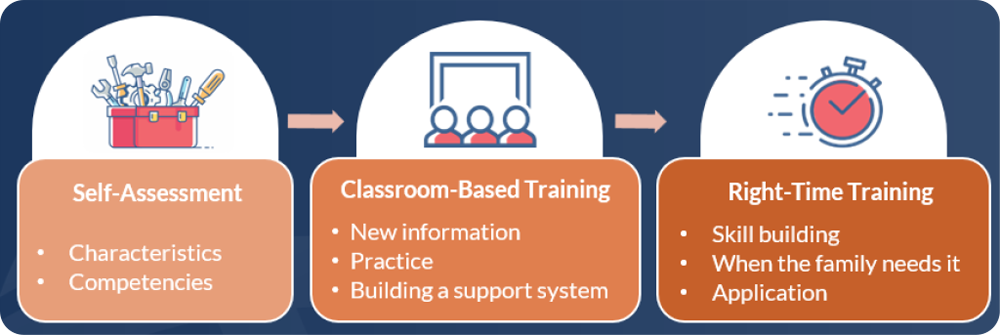
NTDC has three components all of which are equally important in supporting families in gaining the knowledge, skills, and attitudes they need to effectively parent children who have experienced trauma, separation, and loss. These components include a Self-Assessment, Classroom-Based Training, and Right-Time Training.
Self-Assessment
NTDC’s Self-Assessment is a self-discovery tool that provides families who are preparing to become foster, kinship, or adoptive parents the opportunity to learn more about themselves as they consider the characteristics and competencies that are important when parenting children with histories of trauma, separation, and loss. It is designed to be self-administered, which allows participants to recognize and build on their areas of strength, explore areas that would benefit from additional support and information, and identify areas that may cause the most challenges when parenting a child/youth. The Self-Assessment characteristics and competencies are highlighted throughout the curriculum, which supports the continuation of learning beyond the self-assessment.
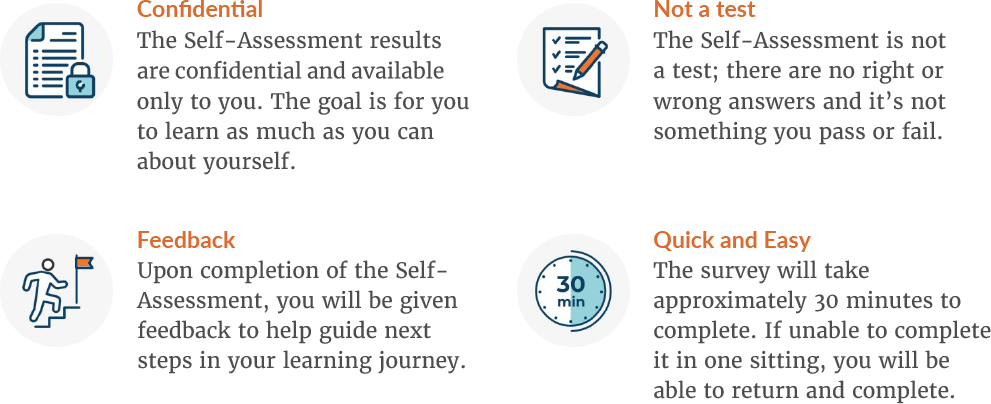
Completing the Self-Assessment: Families can take the Self-Assessment using pen and paper[5] or they can complete it virtually on the Self-Assessment Portal.[6]
Self-Assessment Guide for Families:[7] This guide includes instructions for completing the Self-Assessment survey and translating survey responses into scores and provides recommendations on how to increase knowledge and competence for those competencies and characteristics that have been identified as important when caring for children who have experienced trauma, separation, and loss.
Self-Assessment Guide for Professionals:[8] This guide describes the development and uses of the Self-Assessment and helps professionals better understand what families will experience when they complete the Self-Assessment. It includes the Self-Assessment survey instrument, instructions on how to complete the survey, a scoring guide that offers guidance on how to calculate the scores, and recommendations on how participants can increase their sense of competence for those competencies and characteristics that have been identified as important when caring for adopted children.
Classroom-Based Training
The Classroom-Based Training themes provide a framework to build a strong foundation for parenting children who have experienced trauma, separation, and loss. Parenting children with such experiences requires a wide range of competencies and characteristics, which can be enhanced or built. Through shared learning with others who are parenting through foster care or adoption, and with the facilitation of an experienced professional and parent team, families can provide the healing environment children need. Each Classroom-Based Training theme has clearly delineated competencies. The training provides concrete information on the roles and responsibilities of parents who foster and/or adopt as well as the knowledge, skills, and attitudes they need in order to effectively parent children with histories of trauma and loss.
Completing the Classroom-Based Trainings: NTDC classroom-based sessions are designed to be delivered locally by agency trainers. Families can also complete adoption-specific e-learning versions of these trainings in NCFA’s Adoption Learning Hub.[9]
For trainers: Downloadable materials are available for each theme, including PowerPoint presentations, handouts, videos, evaluation tools, and resources for participants to extend their learning. A Facilitator Classroom Guide is also provided for each theme which contains details about how to use the curriculum materials for that theme. For some themes, a one-hour recorded Train-the-Trainer session and instructional videos for facilitating activities are also available. View the facilitator training materials.[10]
Right-Time Training
Right-Time Trainings are an online component of NTDC that provide ongoing virtual learning to help parents meet their family’s changing needs. Adults learn best when information is applicable to their own situation, and parents who are fostering and adopting need trainings that are easily accessible and available when they need them. As families have children move into their homes, as children go through different developmental stages, and as families encounter new challenges, they need to have a way to access information and tools.
NTDC’s e-learning courses provide foster, adoptive and kinship caregivers with information and resources through the right training at just the right time. Whether you need information to respond to a child in crisis or adjust to new family dynamics, these courses are available to guide you. The Right-Time trainings were designed to meet these needs. They are not intended to replace in-person training and seminars but should supplement this information and provide families with an accessible training tool.
-
Whether you need information to respond to a child in crisis or adjust to new family dynamics, these courses are available to guide you.
-
In each interactive course, through videos and podcasts, participants will hear from child welfare professionals, foster and adoptive parents, and young adults with lived expertise. The e-learning versions will allow complete interactive activities and quizzes that will help you apply what you hear and learn to your individual experience. Each course will also give you suggestions for additional resources you can use to enhance your ongoing exploration of this topic.
Completing the Right-Time Trainings: Families can complete these courses from their mobile phone, tablet, laptop, or desktop computer at any time and place that is convenient using the e-learning platform[11] and through NCFA’s Adoption Learning Hub.[12]
For trainers: Downloadable materials are available for each training, including videos, podcasts, articles, and resources for additional learning. View the facilitator training materials.[13]
The Content
NTDC’s content provides foster and adoptive families with knowledge and skills that will help them to provide a loving, supportive home for their child. The curriculum is designed in a manner that provides agencies with flexibility in what themes are provided to families. NTDC’s modular framework allows each of the one- to two-hour themes to be conducted on their own or stacked with other themes. In addition, the curriculum:
- Includes up-to-date information on trauma, separation, and attachment.
- Uses a layered content learning approach and incorporates the best principles of adult learning by using podcasts, videos, and experiential activities to practice and develop essential skills.
- Features the voices of parents, professionals, and youth.
- Offers comprehensive training for prospective adoptive parents and provides ongoing skill development that parents can access independently throughout their journey.
-
The curriculum incorporates the best principles of adult learning by using podcasts, videos, and experiential activities to practice and develop essential skills.
-
NTDC is a comprehensive no-cost curriculum that tackles separation, loss, grief, and trauma in adoption and foster care. This cutting-edge resource offers adoptive, kinship, and foster parents flexible education to empower them over the course of time and at the right time. There are “key messages” that set NTDC apart:
- Expands the parenting paradigm: NTDC is expanding the parenting paradigm for foster, adoptive, and kinship parents by offering transformational training experiences that help families understand their role in caring for children and help them build new and necessary parenting skills.
- Relatable for families: Understanding and relating to others is a key element in helping foster, kinship, and adoptive parents effectively promote healthy development for children exposed to trauma, separation, and loss. Informed by the personal experiences of members of foster, adoptive, and kinship families, NTDC content ensures that parenting strategies are practical, relevant, and relatable.
- Trauma informed: Understanding trauma and its impact on children is vital for foster, adoptive, and kinship families to have the tools they need. NTDC’s curriculum focuses on providing the tools families need to provide a nurturing environment and promote healthy child development for children with histories of trauma, separation, and loss. NTDC’s Trauma-Informed training was created in partnership with The ChildTrauma Academy and features Dr. Bruce Perry. The focus on trauma throughout the curriculum makes trauma-informed parenting a realistic and achievable goal.
- Flexible and multi-use: NTDC’s comprehensive yet flexible design allows systems to adapt the curriculum to meet the unique needs of families. From podcasts to videos to classroom and Right-Time training, NTDC has a balance of structure and quality content that allows professionals to confidently deliver complex subject matter and tools for practical problem-solving.
- Current and modern: Foster, adoptive, and kinship families need specific support and services that meet them where they are. NTDC’s multimedia content addresses present day needs of families through a combination of self-assessment, facilitated training, and 24/7 access to asynchronous content. Packaged for various adult learning styles and available for parents whether they need detailed explanations on subjects or a quick refresher, the combination of NTDC’s classroom based training, podcasts, and videos “on demand” offer tools for parents that are always right on time.
- Hague compliant: The federal government has regulations (22 CFR § 96.48) requiring prospective adoptive parents to have training on specific topics. NTDC is designed to be compliant with these federal regulations, aside from any child-specific and country specific requirements.
Meeting the Needs of All Families
Spanish language translation: The NTDC curriculum and the associated supplemental guides and resources are now available in Spanish, funded by a donation from Spaulding for Children. These materials were professionally translated from English to Spanish in collaboration with a translation service provider. The translation aimed to use a more neutral or “universal” Spanish to ensure accessibility for Spanish-speaking audiences across the country.
Translation is available for the three curriculum components: classroom-based themes, right time trainings, and self-assessment. This includes PowerPoint presentations, handouts, evaluation tools, and some resources for ongoing learning. Training videos are available with Spanish subtitles. The NTDC website has also been translated, so Spanish-speaking families and trainers can locate and navigate curriculum resources. Spanish facilitator materials can be accessed in the same places as the English versions, and Spanish participant materials are available on the Spanish version of the NTDC website, linked below.
Please note: Resources developed by external sources have not been translated, including documentary clips and some supplementary articles. Additionally, the interactive self-assessment is only available in English.
Accommodations for those with visual and hearing impairments: Each training video has Open Caption and Audio Description versions available for download. Open Caption videos contain subtitles for individuals who are deaf or hard-of-hearing. Videos with Audio Description contain audio-narrated descriptions of a video’s key visual elements. Audio Description videos are for individuals who are blind or visually impaired.
Accessing & Implementing NTDC
All NTDC curriculum materials are available at ntdctraining.org. These materials are free to view, download, republish, or upload to internal websites or learning management systems (LMS). There are no required certifications or trainings to facilitate these materials, and there are no restrictions on how the materials may be used.
There are many avenues for utilizing NTDC curriculum materials. NTDC’s classroom-based training themes were designed to be delivered in a traditional classroom setting but have also been piloted and adapted for use via online synchronous video conferencing. All Right-Time trainings are accessible online and include videos, podcasts, questions and answers, and resources available any time parents need to add to their knowledge or skills.
It is recommended that sites assess how each implementation option fits with their existing structures and/or what work may be needed to develop the structure for professional staff and participants to gain the desired level of access. Some options differ in the level of interactivity, providing materials available for download only, while others allow participants to view videos (such as for Online themes and Right-Time themes) and access the Self-Assessment with automated scoring and feedback. Options also differ as to whether professional staff can monitor participant course completion.
Options for Implementing NTDC:
Self-Assessment Options
- Downloadable format: Self-Assessment PDF
- Interactive online format: Self-Assessment Portal
- Completed directly on the NTDC website. Participants will receive a report with automated feedback based on their responses.
Classroom-Based Training Options
- Downloadable format: Classroom-Based Training Page
- Each training theme includes a “View and Download” button. From there, you can access all the curriculum materials needed such as the Facilitator Classroom Guide, presentation slides, handouts, evaluation forms, resources, videos, and podcasts.
- Interactive online format: NCFA’s Adoption Learning Hub
- These are adoption-specific e-learning versions of classroom-based themes. Search for “National Training” or a specific theme title in NCFA’s course catalog. These courses can be completed directly on the NCFA website. Once participants complete a course, they will be able to download a certificate of completion.
Right-Time Training Options
- Downloadable format: Right-Time Training Page
- Each training includes a “View and Download” button. From there, you can access all the training materials needed such as the training video, evaluation forms, resources, and podcasts.
- Interactive online format: NCFA’s Adoption Learning Hub or NTDC’s E-Learning Page
- These courses can be completed directly on the NTDC or NCFA website. Search for “National Training” or a specific theme title in NCFA’s course catalog. Once participants complete a course, they will be able to download a certificate of completion.
- Downloadable to Your Agency’s LMS
- Upon request, sites can be provided with SCORM-compliant versions of each e-learning course for import into their own Learning Management System (LMS).
- For sites interested in this option, contact ntdc@spaulding.org for additional information.
Implementation Resources
Implementation Manual
The Implementation Manual provides professionals with a background on NTDC’s development and information on all three components of the curriculum. This manual also offers practical considerations for implementation of each component and a roadmap for implementing NDTC with integrity while recognizing the adaptations that may be required to meet unique jurisdictional needs.
The first manual listed below includes implementation considerations for a variety of training audiences including general child welfare, kinship, intercountry, and private domestic adoption. The second manual was tailored specifically to the American Indian Alaska Native population.
Participant Resource Manual
The Participant Resource Manual was developed based on the principles of adult learning theory, providing a structure for participants to engage in critical self-reflection as they complete Online and Classroom-Based themes. The Participant Resource Manual contains all of the handouts that will be needed in the classroom environment and contains a summary of additional resources for each theme that participants can access on their own to support self-directed learning beyond the classroom.
Sites will need to determine how to provide the Participant Resource Manual to families (hard copy or electronic format). In addition, sites may prefer to provide the manual content by theme rather than in one document.
Want to learn more?
Please refer to the resources below. For more information and to access the curriculum materials, visit NTDC’s website at https://ntdctraining.org/.
Still have questions? Email us at ncfa@adoptioncouncil.org and we would be happy to connect with you.
Key Resources, Research, & Additional Links
NTDC Curriculum
- Self-Assessment Options
- Downloadable format: Self-Assessment PDF (for facilitators & families)
- Interactive online format: Self-Assessment Portal (for families)
- Classroom-Based Training
- Downloadable format: Classroom-Based Training Page (for facilitators)
- Interactive online format: NCFA’s Adoption Learning Hub (for families)
- Right-Time Training
- Downloadable format: Right-Time Training Page (for facilitators)
- Interactive online format: NCFA’s Adoption Learning Hub or NTDC’s E-Learning Page (for families)
- Accessing the Curriculum
- Train the Trainer
Guides
- Self-Assessment Guide for Families
- Self-Assessment Guide for Professionals
- Implementation Manual: General Child Welfare, Intercountry, and Private Domestic
- Implementation Manual: American Indian Alaska Native
- Participant Resource Manual: Private Domestic and Intercountry Adoption
- Participant Resource Manual: General Child Welfare
- Participant Resource Manual: American Indian Alaska Native
- Right-Time Training Support Group Leaders Guide
- The NTDC Right-Time Training Guide for Support Group Leaders offers guidance and suggestions for using Right-Time Training in a support group format. The guide describes how to use the content and the construct to facilitate the sharing of Right-Time Training in a manner that can build skills and capacity in families who foster or adopt.
- Home Study Assessment Integration Guide
- The NTDC Home Study Assessment Integration Guide is designed for child welfare professionals who conduct home study assessments. Its purpose is to illustrate how concepts explored in the NTDC classroom based training can be integrated into common areas addressed in a home study assessment.
Evaluation Reports
- 2024 | All Site In-Person NTDC Report | Download
- 2024 | Kinship Self-Assessment Report | Download
- 2023 | An Evaluation of The National Training And Development Curriculum | View and Download
- 2022 | An Evaluation of The National Training And Development Curriculum | Download
- Cost Analysis Report for the NTDC Program in Year 2020-2021 | Download
- Evaluation of the NTDC Right-Time Training | Download
Literature Reviews
- Literature Review of Relative and Non-Relative Foster/Adoptive Parent Factors Related to Placement Stability and Permanence for Children and Youth | Download
- Literature Review of Intercountry Adoption and Private Domestic Adoption | Download
- Literature & Resource Review of Characteristics of Successful Foster, Adoptive, and/or Kinship Caregivers of American Indian, Alaska Native, First Nations, and Native Hawaiian (AIAN/FN/NH) Children and Suggested Training Themes for These Parents | Download
- Systematic Literature Review of Foster and Adoptive Caregiver Factors for Increasing Placement Stability and Permanency | Download
General Publications
- The Role of the National Training and Development Curriculum for Foster and Adoptive Parents in Improving Caregiver Perceived Preparation and Confidence to Parent | Download
- Child Abuse & Neglect Volume 149, March 2024: National training and development curriculum training program impact on placement, permanency, and stability | Download
- Children and Youth Services Review: Assessing Caregiver Usability of the National Training and Development Curriculum for Foster and Adoptive Parents | Download
- Thematic Review from Interviews of Caregiver Factors Related to Placement Stability and Permanence for Children and Youth Experiencing Foster Care or Adoption | Download
- National Training and Development Curriculum: Does Having Access to Online “Right-Time” Training Positively Impact Foster/Adoptive Parenting? | Download
- Research on Social Work Practice: Assessing Foster/Adoptive Parent Training Curriculum’s Improvement of Resource Parent Knowledge and Skills | View
This product was funded by the Children’s Bureau, Administration on Children, Youth and Families, Administration for Children and Families, U.S. Department of Health and Human Services, under grant #90CO1134. The contents of this document are solely the responsibility of the authors and do not necessarily represent the official views of the Children’s Bureau.
References
[1] https://adoptioncouncil.org/national-training-and-development-curriculum/
[2] https://ntdctraining.org/about/key-messages/relatable-for-families/
[3] https://www.youtube.com/watch?v=SN9MId0IRM8
[5] https://ntdctraining.org/wp-content/uploads/2022/09/Self-Assessment-for-Families-June-2022.pdf
[6] https://ntdctraining.org/training-for-families/self-assessment/
[7] https://ntdctraining.org/wp-content/uploads/2022/09/Self-Assessment-for-Families-June-2022.pdf
[8] https://ntdctraining.org/wp-content/uploads/2022/08/Self-Assessment-for-Professionals-June-2022.pdf
[9] https://adoption.talentlms.com/plus/
[10] https://ntdctraining.org/general-curriculum-materials/classroom/
[11] https://ntdctraining.org/wp-content/uploads/2022/09/Self-Assessment-for-Families-June-2022.pdf
[12] https://adoption.talentlms.com/plus/
[13] https://ntdctraining.org/general-curriculum-materials/right-time/
[14] https://ntdctraining.org/es/
[15] https://ntdctraining.org/general-curriculum-materials/accessing-the-curriculum/