

The Impact of Parental Substance Use Disorder on Child Outcomes
It can be difficult to wrap one’s head around the ways in which parental substance use disorder (SUD) can impact children. These effects happen as a result of many different causes, and the causes are complicated and often inter-connected. (1) This diagram highlights some of the potential impacts to the children of parents with an SUD.
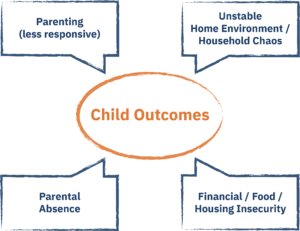
Thinking about these different outcomes can help make it easier to understand a child’s experience living with a parent with an SUD.
TO THINK ABOUT…
Foster, adoptive, and kinship caregivers also need to remember context when thinking about their child’s experiences with SUDs and their family. Kuppens and her colleagues conducted a meta-analysis of 56 studies that looked at the association between parental SUD and child outcomes. They found that over time, there was a lasting relationship between parental SUD and more negative child outcomes. However, “we caution readers to avoid interpreting parental substance abuse as a causal risk factor…and explicitly recognize that parental substance abuse and child well-being may be caused by the same third variable (e.g., financial or marital problems) …” (2)
Impacts on Child Outcomes
Discussed below are some of the primary areas in which children are impacted by having lived with a parent with an SUD before being placed in a foster, adoptive, or kinship home. This list is neither exhaustive nor does it include all areas of a child’s life that could be impacted. Children may present with different impacts, and to different degrees, while others may show none at all.
- Physical Health. Children living with parents with an SUD may be less likely to receive the health care necessary to promote the best physical health. One study of over 100 mothers with substance use assessed whether their children used health care services. The researchers found that almost 25% of the children did not have access to standard health care services in their first 2 years. (3)
- Attachment. Researchers have examined the relationship between parental SUD and attachment in their biological children. Attachment is the emotional connection between the caregiver and infant. The development of a secure attachment requires a caregiver that is responsive to their child’s needs, and parental substance abuse can interrupt that process. Children with parents with SUDs are more likely to demonstrate insecure attachment patterns; “the impact of opioid use on the development of the secure attachment of children can be significant and lead to long-term challenges for children.” (4)
- Behavioral. Research shows that children of parents with SUDs are at an increased risk for behavioral problems. This risk may be because of a genetic risk for these behaviors, or it may be a result of living in a more chaotic home environment. (5)
- Trauma response. Adverse childhood experiences, known as ACEs, are events or circumstances of childhood that impact children in a traumatic fashion and are connected to negative outcomes. Growing up in a household with a parent with an SUD is included on the list of ACEs which children might experience. ACEs have been found to have effects on health and well-being that last into adulthood. ACEs can cause toxic stress, which can hurt children’s brain development, immune system, and ability to react well to stress. (6)
- Risk for Drug Abuse. A longitudinal study in Sweden of nearly 20,000 children found that having a biological parent with a history of drug abuse significantly increased a child’s risk for drug abuse. (7)
What Adoptive/Foster Parents Can Do
It is crucial to remember that the impacts of SUDs will look different for every child. For some children, there are minimal visible effects, while for others, there may be an effect in one particular area. The way SUDs impact a child can change due to many different factors, including:
- The age of the parent starts using substances
- The severity of the parent’s SUD
- The availability of outside social support and resources that help with parenting
- The presence of other disorders with the parent’s SUD
- The presence of other traumatic events, such as parental incarceration or death (e.g. overdose, accident, suicide). (8)
REMEMBER: There are things that the foster, adoptive, or kinship caregivers can do to help children with these experiences!
- Be aware and work to help children. Foster, adoptive and kinship parents can help children be resilient.
- Help children build social skills and become part of positive groups, such as schools, churches, and other communities. (9)
- Become aware of and access available resources and supports, helping to address challenges children might face and build on their existing strengths.
References
(1) Smith, J. C., Alderman, L., Attell, B. K., Rodriguez, W. A., Covington, J., Manteuffel, B., DiGirolamo, A. M., Snyder, S. M. & Minyard, K. (2021). Dynamics of parental opioid use and children’s health and well-being: An integrative systems mapping approach. Frontiers in Psychology, 12, Article 687641. https://doi.org/10.3389/fpsyg.2021.687641
(2) Kuppens, S., Moore, S. C., Gross, V., Lowthian, E. & Siddaway, P. (2020). The enduring effects of parental alcohol, tobacco, and drug use on child well-being: A multilevel meta-analysis. Developmental Psychopathology, 32(2), 765-778. https://doi.org/10.1017/S0954579419000749
(3) Callaghan, T., Crimmins, J. & Schweitzer, R. D. (2010). Children of substance-using mothers: Child health engagement and child protection outcomes. Journal of Pediatrics and Child Health, 47(4), 223-227. https://doi.org/10.1111/j.1440-1754.2010.01930.x
(4) Mirick, R. G., & Steenrod, S. A. (2016). Opioid use disorder, attachment, and parenting: Key concerns for practitioners. Child and Adolescent Social Work Journal, 33, pp. 547-557. https://doi.org/10.1007/s10560-016-0449-1
(5) Bountress, K., & Chassin, L. (2015). Risk for behavior problems in children of parents with substance use disorders. American Journal of Orthopsychiatry, 85(3), 275-286. https://doi.org/10.1037/ort0000063
(6) Centers for Disease Control and Prevention. (2026, March). About Adverse Childhood Experiences. Centers for Disease Control and Prevention. https://www.cdc.gov/aces/about/index.html
(7) Kendler, K. S., Sundquist, K., Ohlsson, H., Palmér, K., Maes, H., Winkleby, M., & Sundquist, J. (2012). Genetic and familial environmental influences on the risk for drug abuse: A national Swedish adoption study. Archives of General Psychiatry, 69(7), 690-697. https://doi.org/10.1001/archgenpsychiatry.2011.2112
(8) Daley, D. C. & Tarter, R. E. (2020, November). Children of parents with SUDs. Counselor. https://counselormagazine.com/article/children-of-parents-with-suds/
(9) Ibid.