
How Substance Use Disorders Affect Family Systems in Foster Care and Adoption
"Substance use disorders (SUDs) are characterized by recurrent use of alcohol or drugs (or both) that results in problems such as being unable to control use of the substance; failing to meet obligations at work, home, or school; having poor health; and spending an increased amount of time getting, using, or recovering from the effects of using the substance. Parent substance use and parent experience of an SUD can have negative effects on children." (1)
About Substance Use Disorders (SUDs)
- Definition: Substance use is described as a disorder when it causes difficulty in someone’s life. This can include health problems, disabilities, and not being able to meet one’s responsibilities at work, school, or home. (2)
- Key point to remember: SUDs are illnesses, which can be treated. They are not a result of lack of willpower, but result when many different causes interact. These can include an individual’s genetics, their environment, and their age when drug use begins. (3)
Understanding Substance Use Disorders (SUDs) in Families
- Having a parent with a SUD can affect children in many different ways:
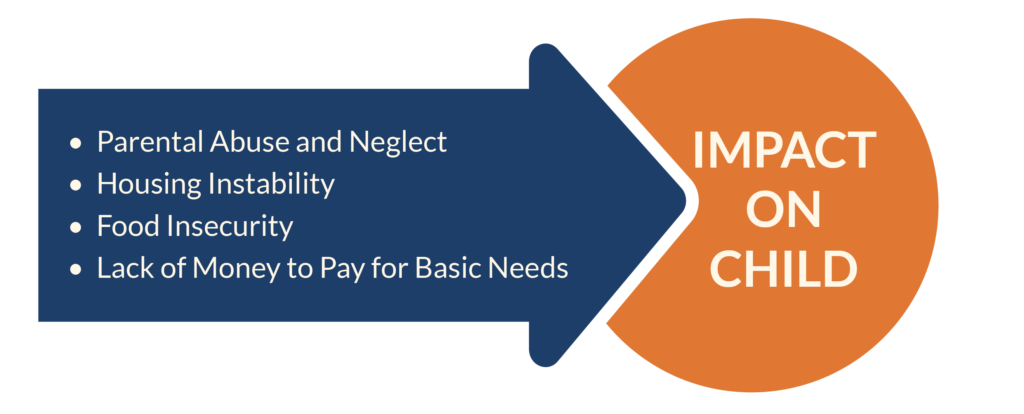
- Children living with parents with SUDs are likely to experience less supervision and more instability in their home environment.
- The very act of parenting itself is impacted by a parent’s SUD. The Child Welfare Information Gateway shares the following characteristics that may be seen in parents with SUDs, all of which can impact the way they parent:
- Difficulty keeping control of their own emotions
- Difficulty understanding and responding to their children's emotions
- Less knowledge of parenting and child development
- Preoccupation with drug seeking
- Not enjoying being a parent
- Problems regulating their aggression
- Using harsher discipline with their children
- Being less involved with and less observant of their children (4)
- A great deal of research shows that children of parents with SUDs are at risk for negative behavioral, emotional, cognitive, physical, academic, and social/emotional outcomes. (5)
The Interaction Between SUDs and Foster Care/Adoption
- Parental substance use plays a major role in many child welfare cases and is a common reason for removal to out-of-home care. Over the past two decades, these cases have steadily increased. (6)
- Studies have found that children who are placed in foster care due to parental drug use are less likely to reunify with their parents. (7)
Impact on Foster, Kinship, and Adoptive Caregivers
- It will be important for caregivers to think about and consider how they feel about an individual with a SUD. It may be challenging to not judge the child’s birth parent. However, it is important to approach the situation with an open and accepting attitude. As Dr. Brett Furst explains in an NCFA Adoption Advocate on the intersection of adoption and addiction, “Addiction is a solution to a problem that the user sees as unsolvable. It is not something to shame or belittle them about. They are not abusing substances because they are unintelligent or do not understand that it is bad for them, or because they truly think they are invincible. They are doing so because they are hurting.” (8) This can be hard for caregivers to wrap their heads around, especially if they perceive that the children in their care are struggling as a result of their birth parent’s addiction.
- A parent with a SUD may demonstrate difficulty keeping appointments. As the organization Abrazo explains, while a child’s birth parent not showing up is frustrating, it is not personal. She may miss an appointment if she knows she will fail a drug test, or she may use her grocery assistance on things she should not. These are issues for an adoption professional to deal with. (9)
- It will fall to caregivers to be open and available to discuss parental drug use with the children in their care.
- Caregivers will need to be open to recognizing and building on the child’s strengths. This often involves seeking additional support and resources to help address the challenges that can arise when a birth parent has a SUD.
Overall, it is important to remember that substance use is a common factor in child welfare and adoption which can impact placement stability/instability, child outcomes, and a caregiver’s relationship with the child’s birth parent. Caregivers can approach the issue with an open mind, an understanding of how children may be impacted, and a commitment to finding the resources necessary for success for the children in their care and their family.
Resources
(1) Lipari, R. N., & Van Horn, S. L. (2017). Children living with parents who have a substance use disorder. Center for Behavioral Health Statistics and Quality, Substance Abuse and Mental Health Services Administration. https://www.samhsa.gov/data/sites/default/files/report_3223/ShortReport-3223.html
(2) Substance Abuse and Mental Health Services Administration. (n.d.). Co-occurring disorders and other health conditions. U.S. Department of Health and Human Services. Retrieved February 9, 2026, from https://www.samhsa.gov/substance-use/treatment/co-occurring-disorders
(3) Substance Abuse and Mental Health Services Administration. (n.d.). What is Substance Use Disorder? U.S. Department of Health and Human Services. Retrieved February 9, 2026, from https://www.samhsa.gov/substance-use/what-is-sud
(4) Child Welfare Information Gateway. (2021). Parental substance use: A primer for child welfare professionals. U.S. Department of Health and Human Services, Administration for Children and Families, Children’s Bureau. https://www.childwelfare.gov/resources/parental-substance-use-primer-child-welfare-professionals/
(5) Kuppens, S., Moore, S. C., Gross, V., Lowthian, E. & Siddaway, A. P. (2020). The enduring effects of parental alcohol, tobacco, and drug use on child well-being: A multilevel meta-analysis. Developmental Psychopathology, 32(2), 765-778. https://doi.org/10.1017/S0954579419000749
(6) National Center on Substance Abuse and Child Welfare. (2024). Prevalence of parental alcohol or drug abuse as a condition associated with removal. Substance Abuse and Mental Health Services Administration, U.S. Department of Health and Human Services. https://ncsacw.acf.gov/research/child-welfare-statistics/interactive-statistics-series/1-2-prevalence-aod-removal/
(7) Lloyd, M. H., & Brook, J. (2019). Drug testing in child welfare: A systematic review. Children and Youth Services Review, 104, 104389. https://doi.org/10.1016/j.childyouth.2019.104389
(8) Furst, B. (2022). The intersection of adoption and addiction. National Council For Adoption. https://adoptioncouncil.org/wp-content/uploads/2022/08/Adoption-Advocate-No.-166.pdf
(9) Abrazo Admin. (2020). When your child’s birthparent is an addict. Abrazo Adoption Associates. https://abrazo.org/2020/08/11/birthparent-is-an-addict/