
Birth Sibling Dynamics: Navigating Contact and Bonds After Adoption
Adoption Advocate No. 193 - Adopted children often have birth siblings, and there are many ways in which birth siblings can remain connected to or find each other after adoption. Learn how to navigate these circumstances.
“When should I talk to my child about their parents?”
“How much should I tell my child about the circumstances of their birth?”
“What if my child has a biological grandparent who wants to be involved?”
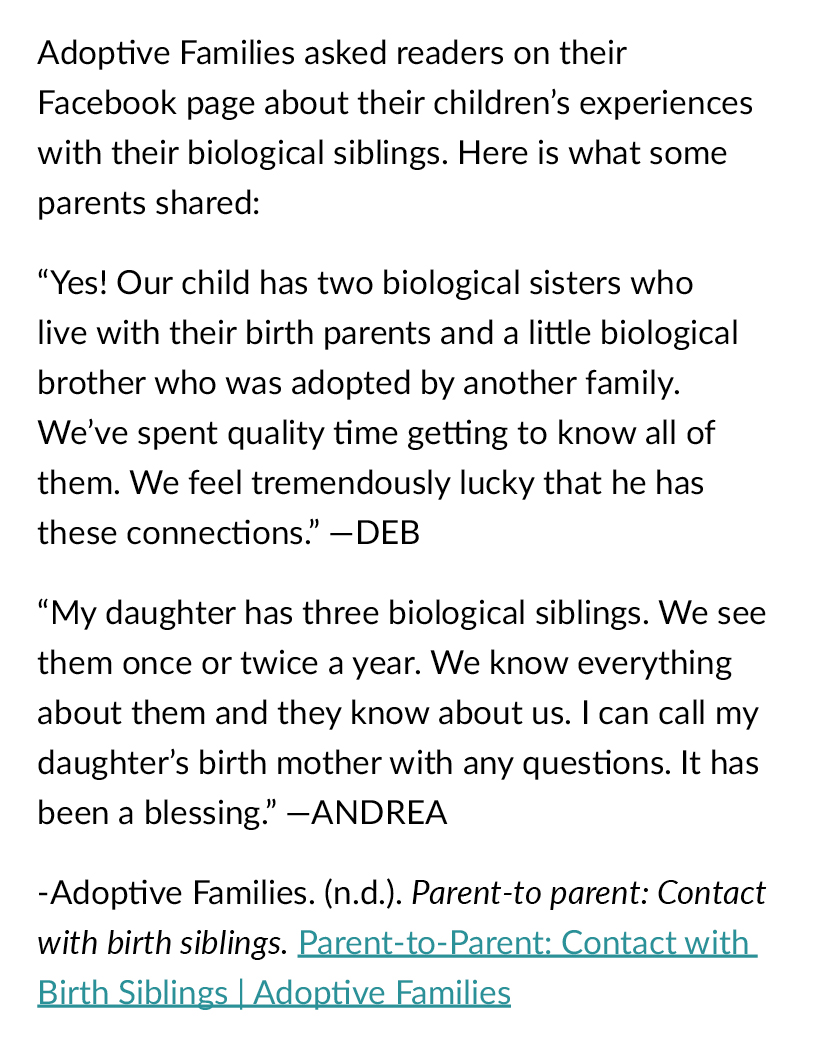
These are all questions that can swirl through the head of an adoptive parent as they are considering the many different conversations they may have with their child. One question that parents often overlook: “When and how will I talk to my child about their biological siblings?” Yet, birth siblings are very common. A survey from Adoptive Families found that 71% of adopted children have known birth siblings, and another 14% have the possibility of them.[1]
There are many different ways in which birth siblings can be a part of a child’s life: birth siblings can be raised by the biological parent(s), or birth siblings can also be adopted, but by a different family. Birth siblings can be older or younger, meaning the decision of the birth parent to keep the child or raise the child looks very different. Each of these scenarios presents unique concerns and circumstances for an adopted individual to grapple with.
The conversation can have an extra layer of complexity if the birth parent has chosen to raise any of your child’s biological siblings (born either before or after them). Children may experience a wide range of emotions when learning about the existence of a birth sibling, including: wondering why they were the one that was placed for adoption when their siblings were not; feeling guilty that they perhaps grew up in better circumstances than their birth siblings; feeling angry that they were not “chosen” to be kept; and imagining what life would have been like if they had been raised with their biological siblings.
While the issues may be different depending on the particular circumstances, open communication with your child is always crucial. An article in Adoptive Families recommends the following considerations for talking about birth siblings:[2]
- Talk about them and make them an integral part of your child’s story from the beginning.
- When talking about birth siblings, keep the language positive.
- If appropriate, ask the birth family for help in explaining the circumstances around birth siblings.
- Express different emotions from different children.
- Be prepared for questions and to have candid conversations.
- Allow the conversation to happen naturally and do not push things.
- Recognize and accept that different emotions, such as curiosity and sadness, may come and go over time.
Maintaining Relationships
Here, we discuss some of the challenges in maintaining relationships with siblings — and, in some cases, even finding siblings—depending on the type of adoption.
Foster Care
Maintenance of birth sibling relationships can be complex and multi-layered, especially in the context of the child welfare system and foster care. Children are placed in out-of-home care, sometimes leading to sibling separation, for reasons associated with experiences of trauma, abuse, and neglect. Barnea and colleagues review the literature that finds that, in the context of child maltreatment, the maintenance of birth sibling bonds has been found to have both positive and negative impacts. They set out to review the literature related to biological siblings in out-of-home placements and found that “siblinghood is an unutilized resource in out-of-home placements.” [3] A review of contact with birth families conducted by Boyle found that both adoptive parents and children stressed the importance of maintaining contact with birth siblings.[4] A study conducted with adoptive families in Wales found that for 24% of the children who had biological siblings listed elsewhere, there were plans in place for face-to-face contact with the sibling. However, even when plans were in place, contact did not always occur due to factors such as logistical challenges and a lack of support from a social worker.
The Mockingbird FamilyTM model provides an example of one method prioritizing birth sibling relationships in the context of foster care. The Mockingbird FamilyTM, which originated in the United States in the early 2000s, presents a model for licensed family-based foster and kinship care. McLaren and colleagues describe the way the model is currently being implemented in Australia, in which multiple foster or kinship families are joined together into micro communities. This type of grouping offers several benefits, including creating additional resources for children and families, providing respite when needed, and offering extra support for families. This model also makes it possible for siblings in different placements to remain connected. In this version of the model, Mockingbird FamilyTM groups even maintain connections with siblings placed outside of the Mockingbird model. The model was found to be effective, as siblings, even those not placed in the same home, stayed meaningfully connected through engaging in fun activities. The authors argue that maintaining these sibling relationships “may help repatriate some of the harm associated with abuse histories, removal, and then unstable placements, and issues with identity formation, connection, and a sense of belonging.”[5]
Private Domestic Adoptions
Contact with birth siblings who have been adopted through private domestic adoption can be handled similarly to contact with other members of the birth family. If the biological sibling is still with the birth parent, then contact between siblings can be specific as part of the post-adoption contact agreement. In cases when biological siblings are adopted by different families, then an agreement must be made between the two (or more) sets of parents.
International
Children adopted internationally frequently do not know whether or not they have birth siblings. Recently, individuals have had some success finding birth siblings through social media and DNA matches. Grace Farrow and Maura Rooney, two sisters only 11 months apart in age and both adopted from China as infants, found each other through DNA tests and share their journey on Facebook, on a page called 2 Journeys to 1 Family.[6] In 2024, as part of their Science of Siblings series, NPR shared the stories of several individuals who had reunited with birth siblings. Some of the stories were joyful, and some were fraught and difficult. Some individuals were shocked to discover they had birth siblings and then welcomed the new relationship. For others, when they reunited, especially if the siblings are still in their country of birth, they realize they have been “separated not only by continents but by a gaping chasm of culture and language.”[7]
Benefits
One key benefit of helping children maintain sibling relationships is the tie it can create to a child’s background and culture. Researchers have found that racial/ethnic socialization by parents can be a key tool in protecting adolescents from the stress that racial discrimination can bring.[8],[9] This type of socialization, which involves understanding and creating awareness of and meaning around one’s own heritage, can be especially challenging in adoptive families where the parents are white and their children are not. Contact with birth siblings is one way to facilitate this type of socialization.
For individuals who reunite with their siblings later in life, finding them can feel like a way to better understand and reclaim a part of their past. And even when contact does not occur in childhood, there is always a possibility for the future. An article in Adoptive Families shares the story of Allison, who reaches out to the adoptive families of her son’s birth siblings every year during the holidays. Even though she does not hear back, she is committed to doing this yearly until her son’s siblings turn 18, and then she will help him reach out to them directly. Other parents use social media to keep track of their children’s birth siblings, even when actual contact does not occur. Allison also uses social media and sees it as a way to help her give her son part of his identity.[10]
Supports
Professional Support
Support from therapists and social workers can be particularly helpful when establishing a sibling relationship. As Meakings and colleagues explain, “When plans for face-to-face contact are agreed, there is an urgent need to ensure appropriate professional intervention is afforded to facilitate and support the necessary arrangements, including the proper preparation of children. It seems plausible that contact practices started early in the adoptive placement may help to cement the development of meaningful sibling bonds.”[11] Additionally, as with any issue related to adoption, it can be very useful to find an adoption-competent therapist in your area.
Written Resources
Written materials can also be helpful in helping your child understand and process the sibling relationship. It can be helpful for families to read about the experiences of other families, such as those in the articles highlighted above. Workbooks also exist, such as The Confusing World of Brothers, Sisters and Adoption: The Adoption Club Therapeutic Workbook on Siblings.[12]
*****
Here we share the real-life story of a sibling reunion. We are so grateful to Judy for sharing her story.
Judy was adopted in Toronto over 50 years ago. She connected with her birth mother many years ago, pre-Internet, through what she describes as “lots of old-fashioned sleuthing.” At the time, her birth mother gave her a good deal of information about who she believed her birth father was, which turned out to be wrong. This meant that Judy had no information about her family on her birth father’s side. Many years later, she decided to try ancestry.com, which turned up a few cousins and an uncle, a few on each side. Then, in the summer of 2023, a big surprise landed in her inbox: a 25% connection, which likely means a half-sibling or an aunt/uncle/niece/nephew.[13] Her husband urged her to follow up, but she was reluctant, due to pursuing leads in the past that didn’t go anywhere. However, curiosity did eventually get the best of her, and she messaged him. Andrew responded immediately and with great enthusiasm. He wanted to talk right away and clarify their relationship. They soon determined that their shared birth father had been a traveling salesman, first working in Canada and then spending some time in New York, where Andrew was born and adopted. Andrew had been on ancestry.com searching for his birth mom, but was completely delighted to find a half-sibling. At one point, later, he told Judy, I stopped searching, “because I ended up with a sister.” Their relationship took off immediately. Andrew brought his whole family to meet Judy and her family, where they currently live in the D.C. suburbs. Their visit centered around seeing Judy perform in a local theater production. She describes the two families as mirror images of each other, each with a husband, wife, and an LGBTQ child. Since then, the two families have seen each other several times, even taking a trip to the beach together. Judy explains, “we just clicked.” She describes the joy of finding someone whom she feels like she has known for a really long time, with no pressure and nothing forced. The two have matching tattoos of DNA, with one red bar to represent the matching 25%.
Sibling relationships are often complicated, and they can become more so when adoption becomes part of the story. It is essential to consider these relationships thoughtfully and carefully to ensure they benefit all parties involved. Sibling relationships and maintenance of those relationships look different and have different considerations depending on the type of adoption and the circumstances leading to the child’s adoption. However, some general guidelines can help parents start and continue conversations about siblings as they navigate these relationships with their children.
References
[1] Oleck, J. (n.d.). Other brothers (and sisters!). Adoptive Families. https://www.adoptivefamilies.com/talking-about-adoption/meeting-birth-siblings/
[2] Herel, B. (n.d.). Bringing birth siblings into our children’s stories – and lives. Adoptive Families. https://www.adoptivefamilies.com/talking-about-adoption/bringing-birth-siblings-into-our-childrens-stories-and-lives/
[3] Barnea, O., Cohen, N., Hindi, I. & Katz, C. (2023). Noticing the unutilized resource of siblinghood: Key conclusions from a scoping review about siblings in out-of-home placements. Child Abuse & Neglect, 141, https://doi.org/10.1016/j.chiabu.2023.106192
[4] Boyle, C. (2017). What is the impact of birth family contact on children in adoption and long-term foster care? A systematic review. Child and Family Social Work, 22, 22-33. https://doi.org/10.1111/cfs.12236
[5] McLaren, H., Patmisari, E., Jones, M., Teekens, K. & Brunes, H. (2024). Keeping siblings in care connected: Improving relationship stability via the Mockingbird Family Model. Australian Social Work, 77(4), 486-499. https://doi.org/10.1080/0312407X.2024.2347618
[6] 2 Journeys to 1 Family. (n.d.). 2 Journeys to 1 Family [Facebook Page]. Facebook. Retrieved September 24, 2025, from https://www.facebook.com/2journeys1family/
[7] Thiagarajan, K. (2024, May 31). When an adoptee reunites with birth siblings abroad: 'There's no instruction manual.' NPR. https://www.npr.org/sections/goats-and-soda/2024/05/31/1249327622/siblings-adoption-international-reunion-birth-family
[8] Leslie, L. A., Smith, J. R. & Hrapczynski, K. M. (2013). Racial socialization in transracial adoptive families: Does it help adolescents deal with discrimination stress? Family Relations, 62(1), 72-81. https://doi.org/10.1111/j.1741-3729.2012.00744.x
[9] Hu, A. W., Zhou, X. & Lee, R. M. (2017). Ethnic socialization and ethnic identity development among internationally adopted Korean American adolescents: A seven year follow-up. Developmental Psychology, 53(11), 2066-2077. https://psycnet.apa.org/doi/10.1037/dev0000421
[10] Herel, B. (n.d.). Bringing birth siblings into our children’s stories – and lives. Adoptive Families. https://www.adoptivefamilies.com/talking-about-adoption/bringing-birth-siblings-into-our-childrens-stories-and-lives/
[11] Meakings, S., Coffee, A. & Shelton, K. H. (2017). The influence of adoption on sibling relationships: Experiences and support needs of newly formed adoptive families. The British Journal of Social Work, 47(6), 1781-1799. https://doi.org/10.1093/bjsw/bcx097
[12] Kupecky, R. M. (2014). The confusing world of brothers, sisters and adoption: The adoption club therapeutic workbook on siblings. Jessica Kingsley Publishers.
[13] For an in-depth dive into the 25% relationship, read the blog post, Half sibling or nibling? A first look at the 25% relationship data. Half sibling or Nibling? A first look at the 25% relationship data | Kitty Cooper's Blog