
Kinship Adoptions: Benefits, Challenges, and Practical Considerations
Adoption Advocate No. 192 - Explore the unique considerations in kinship adoption, including strengths, challenges, and resources specially designed for these families.
What is kinship adoption?
Definition: Kinship adoption refers to the formal legal process when a child is adopted by their grandparents, aunts, uncles, godparents, older siblings, extended family members, or “fictive kin” who are not biologically related but have a strong family-type relationship.[1] Kin may also serve as foster parents, and there are also more informal families in which kinship parenting occurs, without adoption. As defined by the Grandfamilies & Kinship Support Network, “grandfamilies or kinship families are those in which grandparents, other adult family members, or close family friends are rearing children younger than age 18 with no parents in the home.”[2]
The numbers: In FY2022, the Adoption and Foster Care Analysis and Reporting System (AFCARS) showed that least 33% of adoptions from foster care were finalized by relatives or kin.[3] While federal data no longer captures the relationship of adoptive parents to children, approximately 37% of children adopted from foster care in FY2024 were living in a relative or kin foster home immediately prior to adoption, suggesting that kinship care continues to play a substantial role in adoption outcomes.[4] This number is much higher when looking at children being raised by kin outside of formal adoption. According to the Annie E. Casey Foundation, a few million children in the United States are being raised by kinship caregivers each year.[5]
The kinship caregivers: Analysis from the U.S. Government Accountability Office found that for children living with kin, 62% were with grandparents, 25% were with other relatives, and 13% were with non-relatives, most likely close family friends.[6] The AARP describes how the opioid epidemic and other crises contribute to large numbers of grandparents raising grandchildren.[7]
What are the benefits and strengths of kinship adoption?
Research shows that kinship placements are often good for both the child and the family: “…positive child-and family-level outcomes associated with such placements include minimized trauma; improved child well-being and behavioral and mental health; maintenance of sibling relationships, especially for children with multiple siblings; and preserved cultural identity and community connections.”[8] Kinship caregivers often live near the child’s biological parents, allowing the child to maintain a strong sense of family and community.[9] Kinship placements can also often help children retain a strong sense of their history and culture.[10] Kinship placements are associated with higher levels of placement stability and fewer disruptions.[11]

What are the challenges of kinship adoption that might be unique to kinship parenting?
Kinship adoption can happen quickly and is often unplanned. Along with the benefits that come with kinship caregiving, there are also challenges, some of which can be unique to kinship parenting. Kinship parenting is often unexpected. As the Grandfamilies & Kinship Support Network explains, “They often step up to raise children at a moment’s notice – sometimes in the middle of the night – and usually due to a family crisis.”[12] These caregivers may not be emotionally prepared to raise a child, and they may also lack the necessary infrastructure. For example, for a grandmother living in senior-only housing, finding a space for a crib and a baby can be tricky.
The speed with which kinship placements occur can also mean limited time for emotional preparation and information-gathering. As Christine Tangel from Spence-Chapin Services to Children and Families explains in the NCFA Adoption Advocate The Hidden Hurdles and Benefits of Kinship Care and Adoption, “Kinship families often do not have the luxury of a well-researched path to parenting.” As a result, pre-placement training and support can often be quite limited and are more likely to occur once the child is already situated with the family.[13] Additionally, individuals who adopt kin frequently have not gone out in search of adoption, but rather it has come to them.
"When young people must enter foster care, kinship placements with relatives or close family friends can provide a sense of continuity: connections to history, culture and community. While these placements offer many benefits, they come with unique challenges as caregivers quickly assume new parenting duties, navigating relationships with the children in their care and birth parents while guiding these children through the pain of separation.”
- Annie E. Casey Foundation, 2025
Equipping Kinship Caregivers for Success - The Annie E. Casey Foundation
Kinship adoptions often come from situations involving trauma and/or loss. Kinship adoptions often occur as a result of great trauma or loss. As a family member is learning that a loved one has been in a terrible accident or is dealing with addiction or mental health issues, they may also be realizing that they are being asked to care for and/or adopt that person’s child. “To complicate matters further, these soon-to-be adoptive parents are also having their own reactions to the news that a sister, brother, cousin, parent, daughter, or son is in such a difficult situation. Immediately, they are put in a new role and asked to focus on the child or children needing care.[14]
“Typical” adoption education and training may not feel relevant when adopting a family member. Individuals who are adopting kin may feel that some of the required education involved in adoption are not relevant to them. A grandmother who has known a child for the child’s whole life may resent being asked to learn about adoption themes or trauma-informed parenting. She may be offended if an adoption professional suggests that therapy or counseling may be useful for the family. Adoption professionals need to be aware of these potential roadblocks towards building rapport and being able to effectively support a family.
Decisions about the level of contact with the birth family can be especially challenging with kin adoption. With kinship parenting and adoption, it may be tempting to assume that no formal discussion about contact is necessary, since everyone involved is family. However, as Creating a Family explains, having an agreement in place can help ensure a smoother transition and less friction as the child grows. For more information about post adoption contact agreements, see NCFA’s publication, Post Adoption Contact Agreements: What They Are, What They Include, and How They Help.[15]
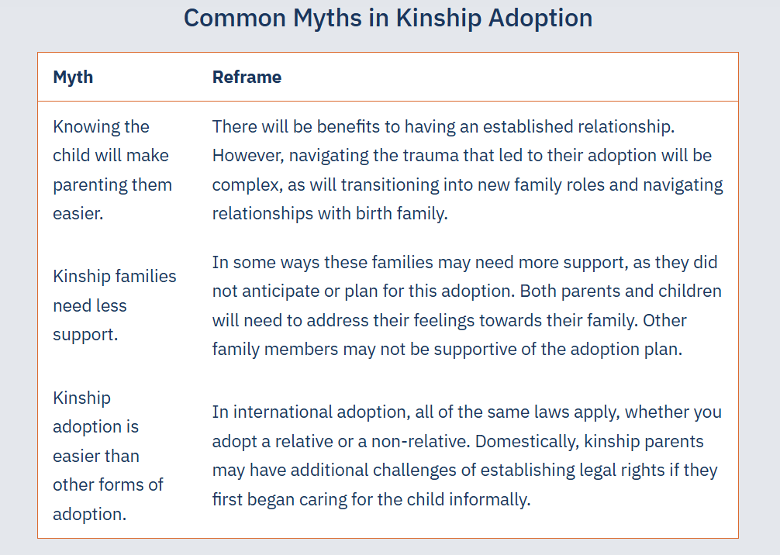
This chart from NCFA’s The Hidden Hurdles and Benefits of Kinship Care and Adoption outlines some of the myths that persist in kinship adoption. Acknowledging and recognizing these myths can make it easier for kinship families and adoption professionals to work to counter them.[16]
What are the practical considerations?
Process. There are no laws specifically governing kinship adoption. Just as with all families, the process will differ based on the type of adoption: foster care, private domestic, or intercountry. For international adoption, the child must meet the definition of “orphan” per the U.S. Citizenship and Immigration Services (USCIS). As Creating a Family explains, “Children that are adopted to US citizens must meet the definition of “orphan” per USCIS to be considered eligible for a US visa as your child. While the court in most countries will process an adoption without regard to the child’s legal status, the US has very strict criteria in which they determine if the child is eligible.”[17] Creating a Family also stresses the importance of using adoption professionals, even if it feels like it might not be necessary, particularly with intercountry adoption. “However, it would be best if you did not try to adopt a child on your own in the country of their birth without the support and knowledge of an adoption agency in the US accredited under the Hague Treaty.”[18] Additional information is available on the “orphan” adoption process from USCIS.[19]
Cost. The cost of kinship adoption can vary considerably depending on the type of adoption and the state in which it occurs. If the adoption occurs through the foster care system, there is generally no fee. For private domestic adoptions and intercountry adoption, the fees are similar to those of non-kin adoptions and include attorney fees for domestic adoption, home study fees, and travel costs.[20]
What resources are available to kinship families?

- One of the first ways to connect with local resources is by contacting your state’s kinship navigator program. These programs are designed to provide kin caregivers with information, education, referrals, and linkages to local resources. As described by Casey Family Programs, “Kinship navigator programs offer information, referral, and follow-up services to kin caregivers to connect them with benefits and services that they or the children need.”[21] This can include things like:
- Helping caregivers apply for public benefits such as TANF and SNAP
- Providing information and referral systems
- Offering concrete goods to families
- Providing legal advice to families
The Grandfamilies & Kinship Support Network provides a list of kinship navigator programs by state.[22]
- The National Research Center on Grandparents Raising Grandchildren is a collaboration between Georgia State University and Western Michigan University. It is designed to share information that is specifically focused on grandparents raising grandchildren. They publish GrandFamilies: The Contemporary Journal of Research, Practice, and Policy, which is the first online peer-review journal focusing on kinship families.[23]
- This blog from Creating a Family discusses and shares resources for the crucial role of protecting the caregiver’s mental health.[24] Support groups can help kinship parents to have a safe place to voice their struggles, fears, and frustrations. As Tangel shares:
After attending a support group, one couple parenting their granddaughter due to their daughter’s struggles with substance abuse said, “Thank you for seeing us as a family. We still have hope for our daughter and we don’t like being written off as a ‘dysfunctional family.’”[25]
- Generations United maintains a database of programs across the country that are intergenerational.[26]
- It is beneficial to find trainings and curriculum that are specific to kinship care and adoption and recognize that kinship adoption is not “adoption as usual." For example, the Casey Foundation’s video training series, Coping With the Unique Challenges of Kinship Care, is a resource for kinship caregivers, which includes topics such as: changes in family dynamics; caregivers’ feelings of loss, ambivalence, and guilt; and approaches and strategies to providing safety and permanency for the young child in their care.[27] The National Training and Development Curriculum has two themes specifically built for training Kinship Caregivers: Kinship Parenting and Building Parental Resilience for Kinship Caregivers.
Conclusion
Kinship parenting can be extremely beneficial for children, families, and society as a whole. However, it can also bring with it unique challenges. Kinship adoption is not “adoption as usual," and it is vital to consider both the unique strengths and challenges it carries. Services and supports do exist for kinship families, and we must work to ensure that families are aware of them and that they are helpful and accessible.
References
[1] Lowe, E. (2022, March 22). Kinship adoption. National Council For Adoption. https://adoptioncouncil.org/article/kinship-adoption/
[2] Grandfamilies & Kinship Support Network. (2022). NCBA infographics: English (rev. Hover 11-21-22) [Infographic]. https://www.gksnetwork.org/wp-content/uploads/2022/12/NCBA_Infographics_Eng_rev_Hover_11_21_22.pdf
[3] Children’s Bureau (2024). The AFCARS dashboard (print version): Preliminary FY 2022 estimates as of May 9, 2023 – No. 30. U.S. Department of Health and Human Services, Administration for Children and Families, Administration on Children, Youth and Families. https://acf.gov/sites/default/files/documents/cb/afcars-report-30.pdf
[4] Children’s Bureau. (2025). The AFCARS dashboard (print version): Preliminary FFY 2024 estimates as of September 5, 2025 – No. 32. U.S. Department of Health and Human Services, Administration for Children and Families, Administration on Children, Youth and Families. https://acf.gov/sites/default/files/documents/cb/2024-afcars-dashboard-printable.pdf
[5] KIDS COUNT Data Center. (2025). Children in kinship care (Table 10455) [Data set]. The Annie E. Casey Foundation. https://datacenter.aecf.org/data/tables/10455-children-in-kinship-care?loc=1&loct=1#detailed/1/any/false/2638,2554,2479,2097,1985,1757/any/20160,20161
[6] U.S. Government Accountability Office. (2020). Child welfare and aging programs: HHS could enhance support for grandparents and other relative caregivers (GAO-20-434). https://www.gao.gov/products/gao-20-434
[7] Baime, A. J. (2024, June 20). When grandparents are called to parent — again. AARP. https://www.aarp.org/family-relationships/grandparents-become-parents-again/
[8] Lorthridge, J., Reyes, L. M., Rosman, E. & Kaye, S. (2023). Happy, healthy, and needs met: How kinship caregivers define success and well-being. Child Welfare, 101(4), 153-177. https://www.jstor.org/stable/48758482
[9] Sutphin, S. T. (2015). Using kinship navigators to assess the needs of kinship caregivers. GrandFamilies: The Contemporary Journal of Research, Practice and Policy, 2(1). https://scholarworks.wmich.edu/grandfamilies/vol2/iss1/3/
[19] The Annie E. Casey Foundation. (2025, May 5). Equipping kinship caregivers for success [Blog post]. https://www.aecf.org/blog/equipping-kinship-caregivers-for-success
[11] Osborne, J., Hindt, L. A., Lutz, N., Hodgkinson, N. & Leon, S. C. (2021). Placement stability among children in kinship and non-kinship foster placements across multiple placements. Children and Youth Services Review, 126, https://doi.org/10.1016/j.childyouth.2021.106000
[12] Grandfamilies & Kinship Support Network. (2025). Who are grandfamilies and kinship families? https://www.gksnetwork.org/who-are-grandfamilies-kinship-families/
[13] Tangel, C. (2022, March 18). The hidden hurdles and benefits of kinship care and adoption. National Council For Adoption. https://adoptioncouncil.org/publications/the-hidden-hurdles-and-benefits-of-kinship-care-and-adoption/
[14] Ibid
[15] Rosman, E. (2025, August 20). Post adoption contact agreements: What they are, what they include, and how they help. National Council For Adoption. https://adoptioncouncil.org/publications/post-adoption-contact-agreements-what-they-are-what-they-include-and-how-they-help/
[16] Tangel, C. (2022, March 18). The hidden hurdles and benefits of kinship care and adoption. National Council For Adoption. https://adoptioncouncil.org/publications/the-hidden-hurdles-and-benefits-of-kinship-care-and-adoption/
[17] Creating a Family. (2016, February 18). International kinship adoption. https://creatingafamily.org/adoption-category/international-kinship-adoption/
[18] Creating a Family. (2024, October 10). 8 tips to ease the transition of kinship adoption. Creating a Family. https://creatingafamily.org/kinship/kinship-blog/8-tips-to-ease-the-transition-of-kinship-adoption/
[19] U.S. Citizenship and Immigration Services. (2023, July 24). Orphan process. U.S. Department of Homeland Security. https://www.uscis.gov/adoption/immigration-through-adoption/orphan-process
[20] Lowe, E. (2022, March 22). Kinship adoption. National Council For Adoption. https://adoptioncouncil.org/article/kinship-adoption/
[21] Casey Family Programs. (2023). Kinship navigator programs (Strategy Brief). Casey Family Programs. https://www.casey.org/media/23.07-QFF-SF-Kinship-navigator-programs.pdf
[22] Grandfamilies & Kinship Support Network. (n.d.). Kinship navigator programs around the United States. Grandfamilies & Kinship Support Network. https://www.gksnetwork.org/resources/kinship-navigator-programs-around-the-united-states/
[23] Western Michigan University. (n.d.). Grandparents raising grandchildren. Western Michigan University. https://wmich.edu/grandparenting
[24] Creating a Family. (2024, October 17). The vital role of kinship caregivers. Creating a Family. https://creatingafamily.org/kinship/kinship-blog/the-vital-role-of-kinship-caregivers/
[25] Tangel, C. (2022, March 18). The hidden hurdles and benefits of kinship care and adoption. National Council For Adoption. https://adoptioncouncil.org/publications/the-hidden-hurdles-and-benefits-of-kinship-care-and-adoption/
[26] Generations United. (n.d.). Intergenerational program database. https://www.gu.org/home/ig-program-database/
[27] The Annie E. Casey Foundation. (2018, October 16). Training series: Coping with the unique challenges of kinship care. The Annie E. Casey Foundation. https://www.aecf.org/blog/training-series-coping-with-the-unique-challenges-of-kinship-care/