
Supporting Expectant & Birth Parents
Gain foundational knowledge and practical skills to compassionately and competently support patients navigating infant adoption decisions. Earn CME/CE credits at no cost.

Choose the Track Built for Your Practice
Select the online training length that fits your schedule. All versions award free CME, Social Work CE, and IPCE credits.
Understanding Infant Adoption 7 - 1.5 hrs
Cost: FREE
Ideal for:
Physicians, Students, Educators, and Administrators (OB/GYNs, Pediatricians, ER, Residents, and Leadership)
Understanding Infant Adoption 7 - 2.5 hrs
Cost: FREE
Ideal for:
Nursing & Maternity Leadership (L&D Nurses, Midwives, and Department Heads)

Understanding Infant Adoption 7 - 4.5 hrs
Cost: FREE
Ideal for:
Pediatric Social Work Specialists
Understanding Infant Adoption 7 - 6.5 hrs
Cost: FREE
Ideal for:
Perinatal Social Work Specialists
Evidence-Based Perspectives on the Adoption Journey
Our curriculum is backed by professional expertise and the lived experiences of those at the center of adoption. Explore the goals and the impact of adoption-sensitive care through their first-hand observations and insights.
The Clinical Goal
Jennifer Woolley
RN and Hospital Adoption Care Coordinator
The Importance of Adoption Competence
Saara McEachnie
Agency Director of Adoption Programs
Supporting Expectant Parents in Healthcare
Janelle Basham
Birth Mother Advocate
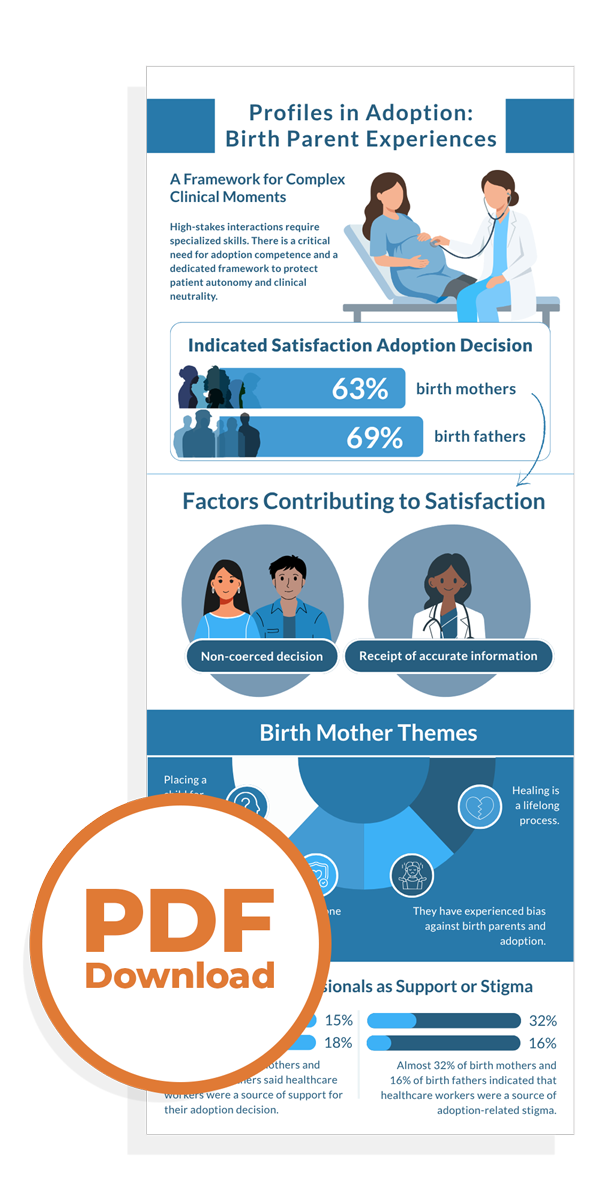
A Framework for Complex Clinical Moments
High-stakes interactions require specialized skills. There’s a critical need for adoption competence and dedicated guidance to protect patient autonomy and clinical neutrality.
Adoption Satisfaction
- 63.3% of birth mothers and 68.5% of birth fathers indicated satisfaction with their decision for adoption.
Factors Contributing to Satisfaction
- For birth mothers, not being pressured into adoption and receipt of accurate information were the most significant predictors of adoption satisfaction.
- For birth fathers, receipt of accurate information is the strongest predictor of satisfaction.
Birth Mother Themes
- Putting a child up for adoption was a decision they “had to make.”
- It was important to have someone they could trust and rely on during the adoption process.
- They’ve experienced bias against birth parents and adoption.
- Their journey of healing is an ongoing process.
Healthcare Professionals as a Source of Stigma or Support
- 17.6% of birth mothers and 15.3% of birth fathers indicated healthcare workers were a source of support for their adoption decision.
- 31.7% of birth mothers and 15.8% of birth fathers indicated healthcare workers were a source of adoption-related stigma.
Why Enroll?
The training is free. The impact is lasting.

Accredited & National
Evidence-based, federally funded curriculum.

Free CME/CE/IPCEs
Available for physicians, nurses, PAs, social workers, and healthcare teams.

Online & Self-Paced
Complete your training whenever and wherever it’s convenient.

Zero Cost, No Barriers
Just better care for the patients who need it most.
About Adoption-Sensitive Clinical Care (ASCC)
Adoption-Sensitive Clinical Care is a federal, grant-funded training program developed through a collaborative partnership between the National Council For Adoption (NCFA), Spaulding for Children, The Adoption and Foster Care Clinic, and the University of Washington School of Social Work, in cooperative agreement with the federal Children’s Bureau.
Visit our project website to learn more about our mission, sign up to receive curriculum updates, request technical assistance, and become an ASCC trainer.
The Adoption-Sensitive Clinical Care initiative is supported by the Administration for Children and Families (ACF) of the United States (U.S.) Department of Health and Human Services (HHS) as part of a financial assistance award (award #90CO1147-01-00) totaling $2,000,000 with 100% funded by ACF/HHS. The contents are those of the author(s) and do not necessarily represent the official views of, nor an endorsement by, ACF/HHS or the U.S. Government. For more information, please visit the ACF website, Administrative and National Policy Requirements.